Trint's Calculus Blog
Monday, May 2, 2016
Monday, March 21, 2016
This Blog be Spinnin'
3.18 Blog Post
- Identify the difference between rotating around a vertical line and a horizontal line.
- When rotating around the x-axis, the important variable is y because it becomes the radius of the figure being formed. When rotating around the y-axis, the important variable is x because it becomes the radius of the former figure.
- What is the difference between creating a washer and a disk?
- When a washer is created, the two radii must be subtracted from each other in order to find the volume of the the existing figure. When a disk is created, there is only one radius for the whole figure so it is not necessary to subtract.
- Identify two examples that use rotating about a vertical line and a horizontal line.
Example #1:
Example #2:
Thursday, February 25, 2016
Tuesday, January 12, 2016
Blog Post 7: Get Optimized
1. What is Optimization?
Optimization involves using the first derivative to find a maximum or minimum. Several optimization problems are word problems, so there are multiple equations involved. In order to find what you are looking for you will have to pick a variable to solve for, then plug the equation into one of the other equations. After getting all the variables to be the same and in one equation, you can then find the first derivative and solve for the missing variable, then plug that value in to find the variable you solved for first.
2. Find the point on the line y = 2x + 3 that is closest to the origin.
In this optimization problem, there are two equations involved. the original equation of y = 2x +3 and the distance formula. Since y is already solved for, you plug it into the distance formula. This is so the only variable in the formula now is x. This allows you to solve for x. To solve for x you must square everything in order to eliminate the radical. Once the radical is eliminated you can find the first derivative using the chain rule and the power rule. Once you've found the first derivative you need to set it equal to zero then solve for x. this gives you the x - coordinate for the point you are looking for. Then, in order to find the y- coordinate you simply plug the x value you just found into y = 2x + 3. This will give you your y - coordinate and then you have found the point on y = 2x + 3 that is closest to the origin.
3.
Optimization involves using the first derivative to find a maximum or minimum. Several optimization problems are word problems, so there are multiple equations involved. In order to find what you are looking for you will have to pick a variable to solve for, then plug the equation into one of the other equations. After getting all the variables to be the same and in one equation, you can then find the first derivative and solve for the missing variable, then plug that value in to find the variable you solved for first.
2. Find the point on the line y = 2x + 3 that is closest to the origin.
In this optimization problem, there are two equations involved. the original equation of y = 2x +3 and the distance formula. Since y is already solved for, you plug it into the distance formula. This is so the only variable in the formula now is x. This allows you to solve for x. To solve for x you must square everything in order to eliminate the radical. Once the radical is eliminated you can find the first derivative using the chain rule and the power rule. Once you've found the first derivative you need to set it equal to zero then solve for x. this gives you the x - coordinate for the point you are looking for. Then, in order to find the y- coordinate you simply plug the x value you just found into y = 2x + 3. This will give you your y - coordinate and then you have found the point on y = 2x + 3 that is closest to the origin.
3.
Monday, December 7, 2015
Implicitly Differentiating the World
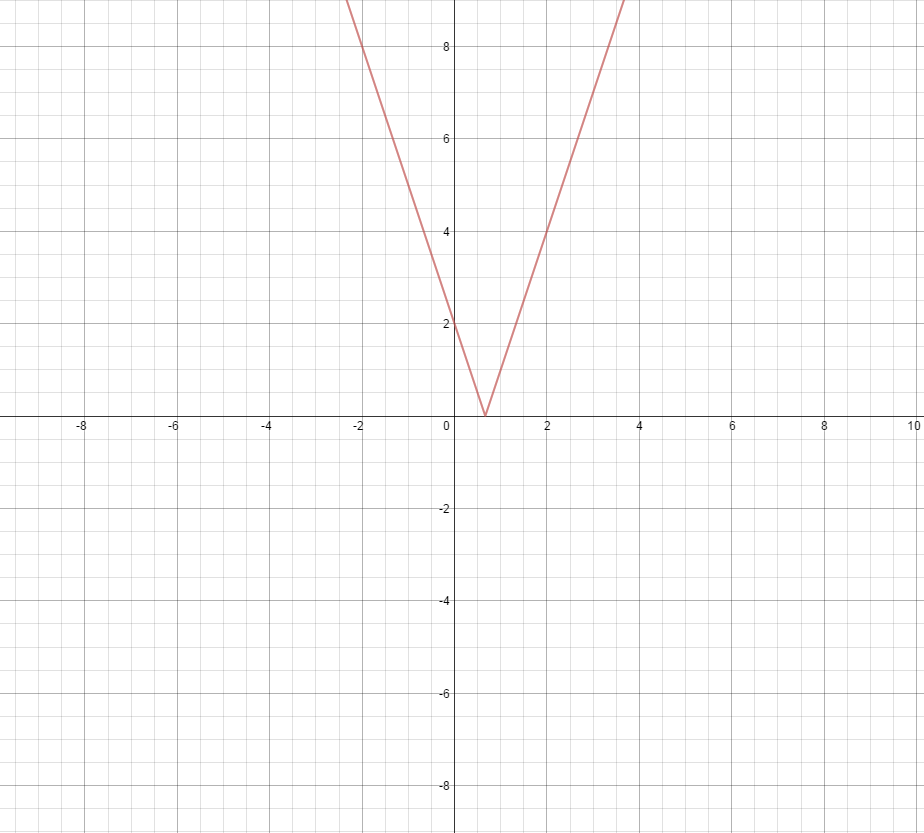
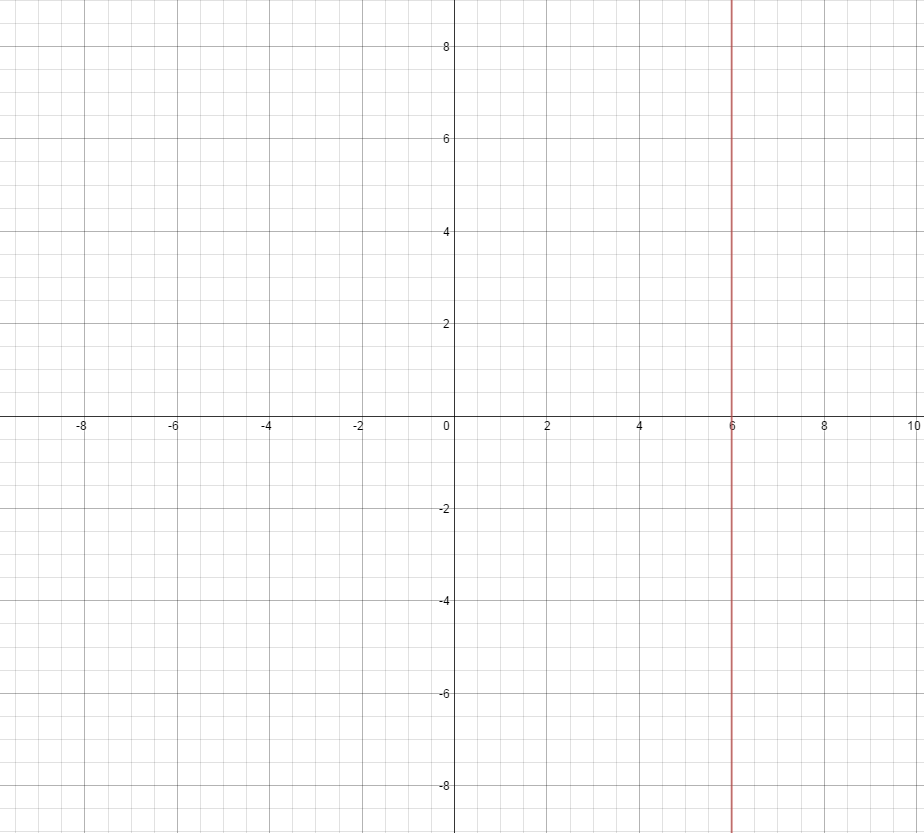
1. Four types of graphs/functions that do not have a derivative are the horizontal line, the vertical line, the absolute value function, and the cusp graph.
Absolute Value

Vertical Line

2. During the process of implicit differentiation you are trying to find Dy/Dx. To do this you take the derivative of the function and using the necessary method and for each variable you take the derivative of you multiply by either Dx/Dx or Dy/Dx, depending of the variable. Then you get all the Dy/Dx on the same side then solve for Dy/Dx.
3. The most important thing to remember in a related rate problem is to always multiply by the proper term when you take the derivative of a variable.
Absolute Value

Vertical Line

2. During the process of implicit differentiation you are trying to find Dy/Dx. To do this you take the derivative of the function and using the necessary method and for each variable you take the derivative of you multiply by either Dx/Dx or Dy/Dx, depending of the variable. Then you get all the Dy/Dx on the same side then solve for Dy/Dx.
3. The most important thing to remember in a related rate problem is to always multiply by the proper term when you take the derivative of a variable.
Thursday, November 5, 2015
Blog post 5
1. f' = 0 represents a possible maximum or minimum. This is because f'=0 is when the slope of f equals 0, so the function changes direction.
2. You can identify where a function increases and decreases by finding the derivative. When you find the derivative, you can plug in a value for x, in order to find the slope of the function at that point.
f'(x) = (1 - 2x)^(1/2)
f'(x) = 1/2(1 - 2x) ^ (-1/2) (-2)
f'(x) = -2/2(1 - 2x)^(1/2)
f'(x) = -1/sqrt(1 - 2x)
Find tangent line at x = -7.5
f(-7.5) = sqrt(1 -2(-7.5)) = sqrt(16)
f(-7.5) = 4
f'(-7.5) = -1 / sqrt ( 1 -2(-7.5))
f'(-7.5) = -1/4
tangent line = y - 4 = -1/4 (x + 7.5)
4. h(x) = f(g(x)) g(-4) = 5 g'(-4) =2 f'(5) = 20. Find h'(-4)
h'(-4) = f'(g(-4))(2)
h'(-4) = f'(5)(2)
h'(-4) =(20)(2)
h'(-4) = 40
2. You can identify where a function increases and decreases by finding the derivative. When you find the derivative, you can plug in a value for x, in order to find the slope of the function at that point.
3. The Chain Rule is a method of find the derivative of a composite function. you begin by working from the outside of the function in. First, you take the derivative of the outside function. Second, you rewrite the interior function. Finally, you multiply by the derivative of the interior function.
f'(x) = sqrt(1 -2x)f'(x) = (1 - 2x)^(1/2)
f'(x) = 1/2(1 - 2x) ^ (-1/2) (-2)
f'(x) = -2/2(1 - 2x)^(1/2)
f'(x) = -1/sqrt(1 - 2x)
Find tangent line at x = -7.5
f(-7.5) = sqrt(1 -2(-7.5)) = sqrt(16)
f(-7.5) = 4
f'(-7.5) = -1 / sqrt ( 1 -2(-7.5))
f'(-7.5) = -1/4
tangent line = y - 4 = -1/4 (x + 7.5)
4. h(x) = f(g(x)) g(-4) = 5 g'(-4) =2 f'(5) = 20. Find h'(-4)
h'(-4) = f'(g(-4))(2)
h'(-4) = f'(5)(2)
h'(-4) =(20)(2)
h'(-4) = 40
Tuesday, October 20, 2015
Blog Post 4
Continuity
A function is continuous if…
1. The limit exists at x=a
2. f(a) exists. In other words, if there is no hole/asymptote
3. The limit at x=a is equivalent to f(a)
Example where function is not continuous:
x+3, x
f(x)= 7, x=2
x^2+3x +1, x>4
This function is not continuous because limit as x approaches 4 from the left does not equal the limit as x approaches 4 from the right.
Intermediate Value Theorem
Working example:
F(x)=2x^2-16 on interval [1,3]
F(1)=2(1)^2-16 →2-16 → f(x)=-14
F(3)= 2(3)^2-16 = 18-16 = 2
Since f is continuous on [1,3] and f(1)< 0 < f(3), then there exists c in [1,3] such that f(c) = 0
failing example:
f(x)=x2+ x -9 on interval [1,2]
f(1)=(1)2 + 1 -9 = -7
f(2) = (2)^2 + 2 -9 = -3
Since f is continuous on [1,2] and f(1)< 0 >f(4), then it cannot be concluded that there exists c in [1,2] such that f(c) = 0
Derivatives
- Type 1: The derivative that is found using the limit as h approaches 0 of the difference quotient. f(x+h) - f(x)/h.
- f(x) = 3x + 2
- 3(x+h) +2 - (3x + 2)/h
- 3x+3h + 2 - 3x - 2/h
- 3h/h
- 3
- Type 2: The derivative that is found using the limit as x approaches a of the slope formula. f(x) - f(a)/ x-a
- f(x)= 4x- as x approaches 1
- 4x-4 - (4(1) -4)/x-1
- (4)(x-1)/x-1
- 4
A.) A derivative is a function that finds the slope of a curve of a polynomial.
B.) for me, the hardest part of finding a derivative is remembering to distribute the negative.
Instantaneous Velocity vs. Average Velocity
Subscribe to:
Posts (Atom)